GME601
A downloadable project for Windows
Portfolio piece for Assignment 2 in GME601
------
Floor
Displacement
For the floor displacement I used a single material and used it for different floor displacement types like puddles and stone/pebbled floor. To achieve this I merged 2 individual materials using: 2d noise, perimeters for tessellation strength and UV blending.
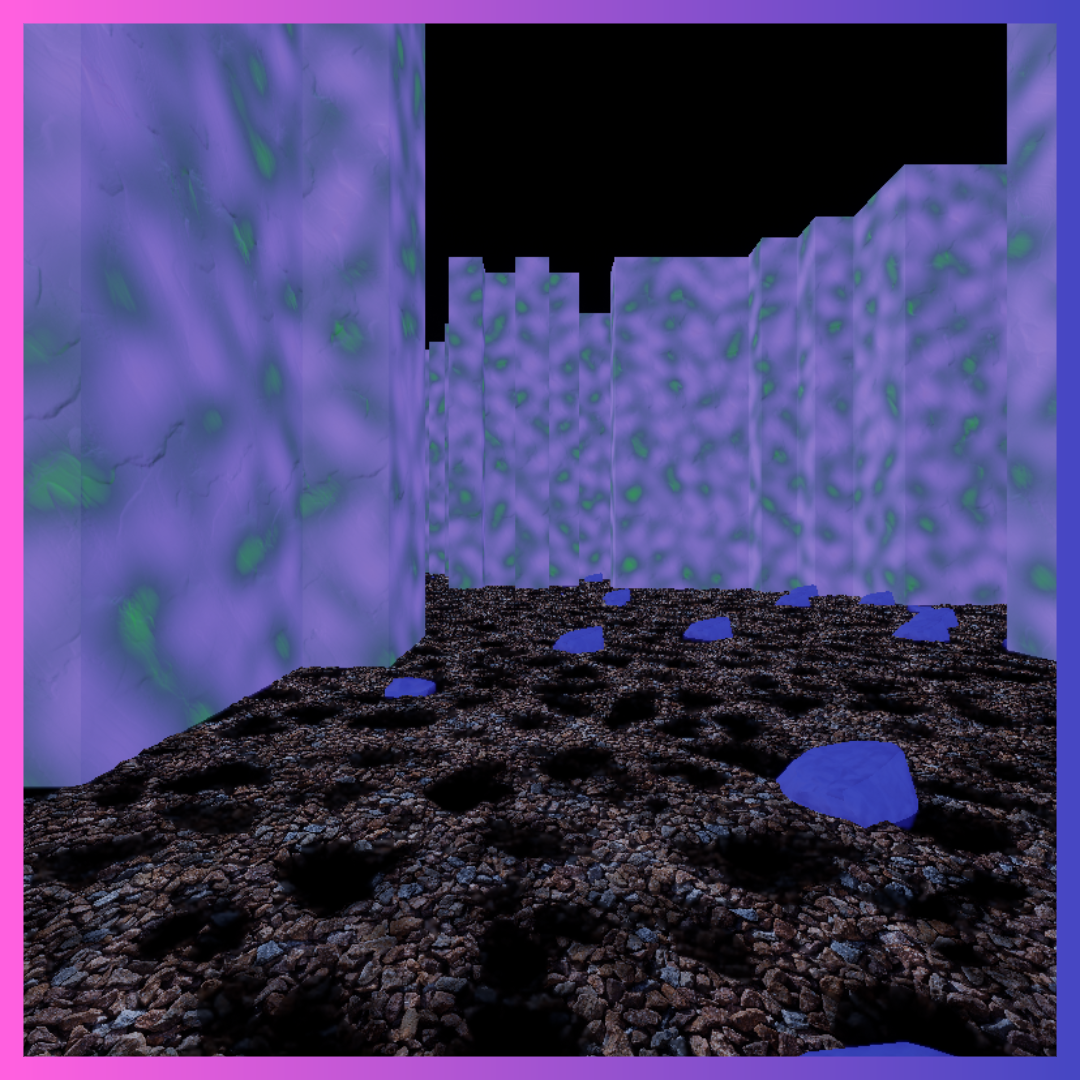
For pebbled floor, I used the displacement map of the stones and increased the UV using parameters to set the size of the pebbles ready for displacement. This technique was also used on the base colour and the puddle generation to also set the same size so style and quality wasn't affected.
I used a 2d noise to make a displacement map for the puddles - the same noise was used in the base colour to make sure the black of the puddles was in the correct position.
Base Colour
The base colour used a coloured variant of the stones and a solid black to a dark grey to give the water laying there a wet kook and also give the water an illusion of deeper water.
Other
The others refer to anything that is part of the project but not worth mentioning in great detail as it's noting major. For this in particular, The Specular, Normal and Ambient Occlusions' UV all get the scaled up. They all also get inverted other than the Ambient Occlusion as that will go around the rocks.
Water
The water is created using 2 normal UVs moving as different speeds and directions. The water moves slowly and opposite to each other making the water look still. The 2 UVs are blended together and then flattened to remove high waves appearing.
The water has also has a main colour for the top and a deep water colour added to it using a hue shift so the look of natural water is added. Scattering is also added to make the look of underwater even better, although it may not show up brilliantly as it is only shallow water and light is not high enough to show scattering like it would be in a pool or similarly used.
------
Walls
Material
The walls' materials have several functions inside it. It has the base colour and its threshold, the normal, the emissive and the noise encompassing everything. The noise that is 3d and uses the R (red) colour mask for the emissive moss and normal locations splitting the wall normal and the moss colour.
The normal has the noise added to its output while the base colour has the noise used as the alpha for a linear interpellation ready for the threshold for the emissive. The output of the threshold is added to another linear interpellation as the alpha. That is multiplied to make the emissive stronger.
------
Cave Generation
Noise Generation
The cave noise is very simple as it is only a 2d noise that is multiplied in size to give the cave more space to look around. Although the noise is very simple to make, it is extremely important towards the creation of the cave as it is the caves wall placement design.
Functions
The functions for this are simple in practise but complex to finetune so they aren't completely perfect. There are 6 functions within the processing:
- Noise map creation - for the wall placement
- Floor and roof placement - using the floor and roof materials
- Inner wall placement - using the wall material
- Outer wall placement - using the wall material
- Texture adding - adding the textures stated after the process
- Rock placement
The noise creation function created the noise and adds it to a texture render.
The floor and roof placement creates the floor and roof alongside the water, placed just under the floor.
The inner wall placement goes through all the pixels inside the texture noise map and creates a wall whenever a white pixel is found.
The outer wall placement places a long wall in the middle of the map size creating a wall alongside the outer part of the cave.
Texture adding just adds the textures to the walls, floor and roof. This is just a function on its own as it keeps it easy to find where problems may arise.
Rock placement is the same as inner wall placement other than it works on white and randomly generates a number. If 1 creates a rock otherwise it doesn't.
This is all done inside a single object and can be generated at any size. The only realistic limitation is the computers power, however the cave is designed to be built at 50x50 or 50x100 as any larger and the displacement gets a bit uneven and strange.
------
Rock Generation
Material
For the material, the main focus was testing texture bombing. I used a rock normal texture and multiplied the UV so it would fit the rocks and also the mix the bombing better.
Random Selection
The Rock placement is very simple as it has a random bool and creates a rock depending if its true and if its false it goes onto a different rock and tries again until one is true and then it spawns that rock.
Download
Leave a comment
Log in with itch.io to leave a comment.